

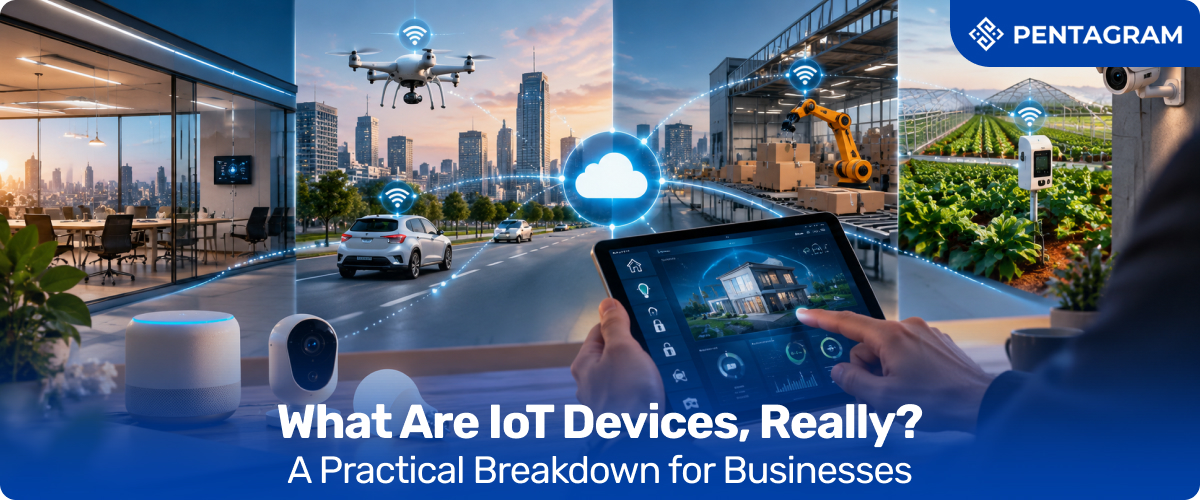
If you recap your day, you will realise that you pass through a plethora of IoT devices without noticing. This can be anything from the badge reader on the door to the temperature sensor in the server room to the smart meter quietly logging usage in the plant room; IoT devices encompass our enterprise ecosystems.
That’s the practical answer to the question: what are IoT devices? The literal definition they hold is that they are physical hardware, fitted with sensors or actuators, that connects to a network and exchanges data without requiring a person to operate it at each step.
This has naturally revolutionised businesses; and this has since stopped being an IT curiosity but an infrastructure decision instead. Every device added to an operation also needs a reliable network, a management plan, and a security posture. This article covers what IoT devices are, how they work, where businesses are already deploying them, and what a connectivity strategy needs to get right to keep them running.
What Is the Internet of Things, and How Do IoT Devices Fit In?
In the broadest sense, the Internet of Things is the cumulative term for a collection of physical objects now embedded with sensors, software, and network connectivity, whose primary objective remains to manage the to-and-fro of data from centralised systems.
- IoT devices are the individual hardware components that make this network real; a single device on its own does very little.
- A smart meter sitting unconnected on a shelf tells nobody anything. It’s only once it has internet connectivity, a route to transmit readings, and a system to interpret them that it becomes useful.
- This is the layer most businesses underestimate when deploying IoT devices: the hardware is often the easy part. The internet connectivity underneath it, reliable enough to carry every reading without gaps, is where most of the real engineering work sits.
How Do IoT Devices Work?
Every IoT device, regardless of size or industry, runs through broadly the same process to turn a physical event into a useful action.
- Sense: A sensor measures something in the physical world – such as temperature, vibration, location, occupancy, or power draw.
- Process: An onboard processor and firmware interpret the raw reading locally, deciding what’s worth transmitting and what can be filtered out before it ever leaves the device.
- Transmit: A connectivity module sends the processed data over a network, whether that’s Wi-Fi, Bluetooth, a low-power wide-area network, or cellular IoT connectivity.
- Act: The receiving system is often cloud-based, and it works by analysing the data and either flags it for a person or triggers an automated response.
- Repeat continuously: Unlike a traditional device that performs one fixed task when switched on, an IoT device keeps this sense-process-transmit-act loop running indefinitely, which is what allows real-time monitoring rather than a single snapshot.
This loop also explains why not every IoT device needs the same type of connection:
- A fixed sensor in a warehouse with mains power can transmit constantly over Wi-Fi.
- A GPS tracker on a delivery pallet moving across the country cannot rely on Wi-Fi at all and instead needs internet connectivity that follows it, typically cellular, rather than waiting for it to come home.
- A battery-powered sensor in a remote location may only transmit a handful of times a day to conserve power, which changes how quickly a business can realistically expect to be alerted to a problem.
The Basic Anatomy of an IoT Device
The “how it works” loop above is made possible by a consistent set of physical components:
- Sensors and actuators: This is what makes it an IoT device in the first place. Sensors measure the physical world; actuators act on it.
- A processor and firmware: They interpret data locally before transmission.
- A connectivity module: The device’s link to the outside world and the component that determines where it can physically be deployed.
- A power source: From mains electricity through to a multi-year battery, shaping how often the device can realistically transmit.
Key Categories of IoT Devices Businesses Actually Use
The sheer range of Internet of Things devices can make the category feel vague, so it helps to group them by where and how businesses deploy them.
- Consumer and smart office devices: Smart thermostats, connected speakers, security cameras, badges and access-control systems. Usually sit inside the building management layer, controlling heating, lighting, and access without a facilities team manually adjusting each one.
- Industrial and manufacturing devices: Condition-monitoring sensors on motors and pumps, vibration and temperature probes on production lines, connected PLCs and gateways. These support predictive maintenance and reduce unplanned downtime. The conditions, however, require them to tolerate heat, dust, and vibration that consumer-grade connectivity was never designed for.
- Logistics, fleet, and asset-tracking devices: GPS trackers, vehicle telematics units, and connected scanners. Among the most common IoT device examples in transport, and by definition mobile, which makes roaming capability and multi-network coverage essential rather than optional.
- Retail and point-of-sale devices: Smart shelf sensors, connected payment terminals, and electronic shelf labels. Give retailers real-time visibility into stock levels and transactions without manual stocktaking.
- Healthcare and remote monitoring devices: Connected medical equipment, remote patient-monitoring wearables, and asset-tracked hospital equipment.
- Utilities and smart metering devices: Smart water, gas, and electricity meters, environmental monitoring stations.
Benefits and Challenges of IoT Devices
IoT devices create real business value, but that value comes with trade-offs worth weighing before a rollout, not after.
Benefits:
- Real-time visibility: Here, the decision is on what’s actually happening right now, with reports on a real-time basis being perceived and acted upon.
- Predictive maintenance: The highly efficient condition-monitoring sensors flag equipment issues before they cause expensive, unplanned downtime.
- Lower operating costs: It involves automated meter reading, stock monitoring, and fleet tracking. This part of the process is quintessential for the reduction of manual labour previously needed to collect the same information.
- Faster, data-backed decisions: This process is how continuous data replaces guesswork, from staffing a store around footfall to routing a delivery fleet around live traffic.
Challenges:
- Security exposure: Every connected device is a potential entry point into the wider network, and the malicious elements know this. The IoT hardware thus is frequently targeted precisely because it’s assumed to be low-risk, along with the highest reward.
- Connectivity reliability: A device that silently drops offline is more dangerous than no device at all, since it creates false confidence that something is being monitored; however, in reality the situation is out of control.
- Scale complexity: Some major issues arise when the system that is manageable at ten devices becomes overstimulated when connected to a thousand devices without centralised oversight.
- Interoperability: Devices from different manufacturers often use different protocols, which can leave a business juggling several disconnected systems instead of one, which can only be mitigated through a centralised protocol.
Why IoT for Business Depends on the Connection, Not Just the Device
It’s tempting to treat IoT device examples as a hardware shopping list: buy the sensors, install them, and the data appears. In practice, the device is rarely the point of failure. The connection underneath it is.
- A sensor that cannot reliably transmit its readings is worse than no sensor at all, because it creates a false sense of visibility. A business assumes something is being monitored when, in reality, the data has been silently dropping for weeks.
- This is precisely why IoT for business has become a connectivity decision as much as a hardware one.
- Deploying a hundred devices across ten sites is not a hundred small projects. It’s one connectivity problem, repeated at scale, and it needs to be treated that way from the outset.
- A device estate spread across multiple sites, or moving between them, needs IoT connectivity solutions that offer multi-network coverage, so a device isn’t dependent on a single carrier’s signal strength at a single location.
- It needs centralised management, so IT teams aren’t logging into ten separate portals to check whether sensors across ten sites are even online.
What Good IoT Connectivity Solutions Actually Need to Do
Businesses evaluating IoT solutions tend to focus first on the device and only later on the network, which is the wrong order. A few things worth establishing before a single sensor goes into production:
- Multi-network coverage: A device tied to one mobile network is only as reliable as that network’s coverage at that exact location. Multi-network SIMs and eSIMs connect to whichever signal is strongest, which matters enormously for anything mobile or deployed across multiple regions.
- Centralised SIM and device management: At ten devices, a spreadsheet works. At a thousand, it doesn’t. A single platform to activate, monitor, suspend, and reassign connectivity across an entire device estate is the difference between IT managing the estate and the estate managing IT.
- Remote provisioning: New sites and new devices shouldn’t mean waiting days for physical SIMs to arrive. Devices should be activatable remotely the moment they’re installed.
- Security built in from the start: Every connected device is a potential entry point. Secure authentication, encrypted data in transit, and visibility into unusual device behaviour need to be part of the connectivity layer, not an afterthought bolted on once something has already gone wrong.
- Room to scale: A pilot of twenty devices should be built on the same connectivity foundation as the eventual rollout of two thousand, not rebuilt from scratch once the pilot proves itself.
IoT Devices and Connectivity Solutions, Brought Together by Pentagram Systems
Everything above points to the same conclusion. IoT devices are genuinely straightforward to buy and install. What determines whether a deployment actually works and keeps working is the connectivity strategy sitting underneath it, and that’s far easier to get wrong than the hardware ever is.
- Pentagram Systems provides IoT SIMs and eSIMs designed specifically for businesses connecting smart devices at scale, built around global and multi-network coverage so devices stay connected across the UK, Europe, and worldwide rather than depending on a single operator’s reach.
- Its Global IoT Connectivity platform supports multi-network SIMs and eSIMs with centralised management, giving businesses uninterrupted performance for devices, vehicles, and sensors wherever they’re deployed.
- SIM Estate Management brings every connected device onto a single platform for monitoring, remote provisioning, and security, so an estate of IoT devices never becomes a collection of unmanaged, invisible risk.
- Whether the requirement is a handful of sensors in one warehouse or a device estate spread across multiple countries, Pentagram Systems builds IoT connectivity solutions around the deployment, rather than offering one fixed package and asking the business to fit around it.
If your business is deploying IoT devices, or already has them, and isn’t entirely confident the connectivity underneath them would hold up under real-world conditions, that’s worth a conversation before it becomes a problem rather than after.
Talk to Pentagram Systems about IoT connectivity built around your device estate.
Speak to a connectivity specialist →
Conclusion
So, what are IoT devices, in the end? They’re the sensors, trackers, terminals, and connected hardware quietly running in the background of almost every modern business, turning the physical world into data a business can actually act on. Individually, they’re simple. At scale, across sites, countries, and device types, they become a genuine connectivity and management challenge, and one that’s far easier to get right from the start than to fix after a thousand devices are already in the field.
Businesses that treat IoT devices as a connectivity strategy, not just a hardware purchase, are the ones getting real value out of them. The rest are often sitting on an expensive collection of sensors they can only partially trust.
FAQs
1. What are IoT devices, in simple terms?
Physical hardware fitted with sensors or actuators that connects to a network and exchanges data automatically, without someone operating it manually. Examples range from a smart thermostat to a GPS tracker on a delivery vehicle.
2. How do IoT devices actually work?
The IoT application process is simple. The sensor measures something in the physical world, a processor decides what’s worth transmitting, a connectivity module sends it over a network, and a receiving system flags it or triggers an automated action.
3. What internet connectivity do IoT devices need?
It depends on the device. A fixed, mains-powered sensor can run on Wi-Fi. A mobile device, such as a tracker or telematics unit, needs cellular IoT connectivity that follows it, ideally via a multi-network SIM not tied to one carrier’s coverage. Getting this choice wrong is one of the most common reasons deployments underperform.

Leave a Reply