

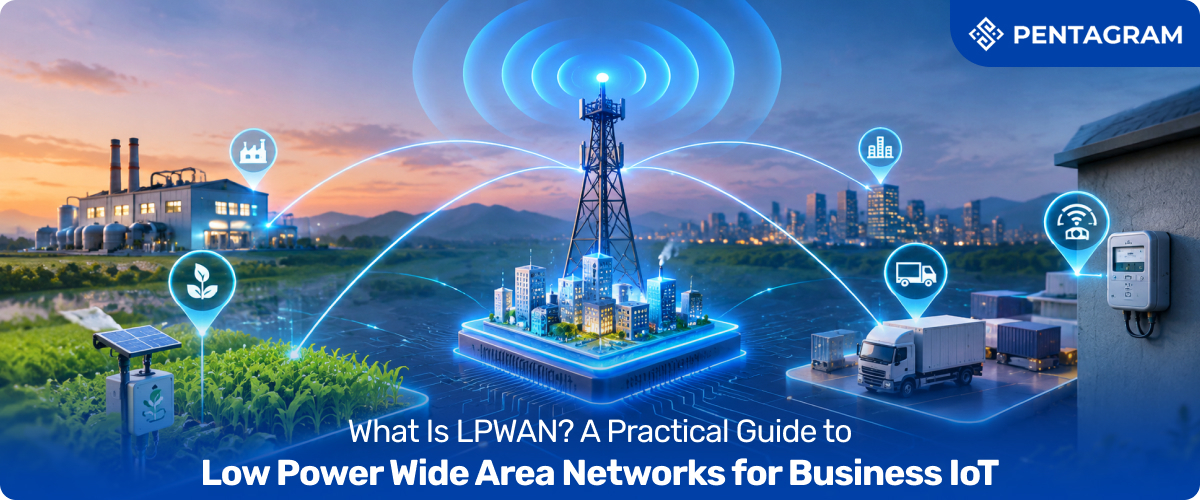
Most of the devices that will shape your business over the next decade won’t look impressive. A water meter in a basement. A tracker on a pallet. A soil sensor at the edge of a field. They send a few bytes now and then, run on a small battery, and are expected to keep going for years. Wi-Fi can’t reach them, and a standard mobile plan is overkill. That gap is exactly where LPWAN comes in.
LPWAN, short for low power wide area network, is a family of wireless technologies built to carry small, infrequent messages over long distances using very little power. This guide covers how it works, the main options, where it fits, the pitfalls most guides skip, and how to keep a large estate visible and under control. Read on if you’d rather choose your connectivity once than twice.
What Is a Low Power Wide Area Network for a Layman?
Picture a mobile network on a strict diet. Instead of carrying video calls and app downloads, a low power wide area network carries tiny messages, such as a temperature reading, a meter value or a “door opened” alert, across several kilometres while sipping energy. The trade-off is speed. LPWAN gives up bandwidth in exchange for range, battery life and a low cost per device.
That bargain suits things that talk rarely and need to last. A sensor sending a few readings a day can outlive a device on a standard 4G plan many times over. LPWAN technology achieves this with narrow channels, simple modems and long sleep cycles, waking just long enough to transmit. Worth remembering, too, that LPWAN is a category rather than a product. LoRaWAN, NB-IoT and LTE-M all sit under the umbrella, and they behave quite differently.
Why LPWAN Technology Matters for Connected Businesses
Three things tend to win over operations teams. Battery life comes first: when a device sits behind a wall or on top of a bridge, every site visit costs money, so multi-year endurance changes the business case. Reach is second, since a single gateway or cell can cover a wide area, and the signal usually performs better in basements and dense buildings than Wi-Fi does. Cost is third. Simple modules and small data volumes keep both hardware and connectivity bills low, turning thousands of devices from an aspiration into a budget line item.
The market is leaning this way too. Vodafone Business notes that low power wide area connections are predicted to overtake standard 4G and 5G data connections by 2030. Whether or not it lands that neatly, the direction is plain: the next wave of IoT is mostly small devices, not big pipes.
The LPWAN Family: LoRaWAN, NB-IoT, LTE-M and Beyond
LoRaWAN is the open option, running in unlicensed spectrum. You can build a private network with your own gateways or join a public one, which gives you control and low running costs, though coverage and security design become your responsibility.
NB-IoT and LTE-M are the cellular siblings, delivered through mobile operators on licensed spectrum. NB-IoT is tuned for very small, infrequent payloads from fixed devices, think meters in basements. LTE-M carries more data and copes with movement, so it suits trackers and assets on the go. Niche players such as Wi-SUN and Wize serve specific jobs like utility and water metering, but for most businesses the real decision sits between LoRaWAN, NB-IoT and LTE-M.
Then there’s Sigfox, the early pioneer, which went through insolvency proceedings in 2022 before a new owner took it over. It’s a useful reminder that you’re picking a network provider as well as a technology.
Cellular IoT vs Non-Cellular LPWAN: Choosing a Side
Cellular IoT rides on operator networks, so you get wide coverage, SIM-based authentication, roaming potential and a provider who answers the phone. The price is a per-SIM charge. Non-cellular options such as LoRaWAN avoid subscriptions and suit private sites, but coverage is yours to build, and international reach is patchy.
| Cellular LPWAN (NB-IoT, LTE-M) | Non-cellular (LoRaWAN) | |
| Coverage | Operator footprint | Your gateways or a public network |
| Security | SIM-based authentication | Depends on how well it’s configured |
| Cost model | Per SIM, monthly | Upfront gateways, low running cost |
| Best for | Mobile, spread-out or cross-border assets | Campuses, farms, single large sites |
If your devices cross borders or keep moving, the cellular side usually earns its premium. Plenty of mature estates mix both. The aim isn’t to crown a winner but to match the network to what each device actually does.
Where LPWAN Earns Its Keep: IoT Applications Across Industries
The most successful IoT applications are almost embarrassingly simple. A leak sensor under a boiler. A fill-level sensor on a waste container, so the lorry only visits when it needs to. A temperature probe in a cold chain that raises the alarm before stock is spoilt.
Utilities use LPWAN for smart metering across thousands of homes. Facilities teams use it for occupancy, air quality and water-leak detection. Logistics firms track pallets and trailers, and farms monitor soil moisture across fields that Wi-Fi will never reach. Retailers watch refrigeration units and stock movement the same way. None of these needs much data. They need reliability, battery life and a bill that doesn’t grow faster than the estate.
The Catches Nobody Mentions: Sunsets, Silent Devices and Sprawl
Networks get retired. AT&T switched off its NB-IoT service in the US from early 2025 and steered customers towards LTE-M, while European operators have stayed committed to both standards. The lesson is that availability varies by country and operator, so check before you design a product around a single standard. Anyone who lived through the UK’s 2G and 3G switch-offs will recognise the pattern.
Then there’s silence. A device built to talk rarely also fails quietly, and a sensor that has been dead for a fortnight looks identical to one that simply has nothing to report. Add devices spread across countries, each with a different local SIM contract, and the estate sprawls fast. Every one of these is solvable, but only if you plan for it at the design stage rather than after deployment.
Why Network Monitoring Solutions Matter When Devices Barely Talk
A laptop that drops offline gets noticed within minutes. A sensor that reports once a day can be dead for a week before anybody asks. That’s why network monitoring solutions are a core requirement for any LPWAN rollout, not a nice-to-have.
Good monitoring tracks last-seen times, data usage per SIM, unusual spikes, such as a faulty device burning through a shared data pool, and connection behaviour across the estate. It then alerts on the exceptions rather than burying people in noise. Alert thresholds matter as much as the data: ten sensible alerts get acted on, while two hundred get muted. It’s a different job from watching switches in a server room, because the things being watched are small, remote and numerous. Our guide on network monitoring explains how to build that visibility properly.
How Pentagram Systems Keeps Global IoT Connectivity Simple
Pentagram Systems works at the layer that decides whether your devices are online, visible and affordable to run. Its IoT connectivity is delivered through multi-network SIM and eSIM services, so devices can connect to available carriers as they move between regions, which cuts downtime from coverage gaps and outages. Data models are flexible too: pay-as-you-go, pooled or bundled, matched to how your devices really behave.
Everything is managed from one centralised platform, with live device status, usage and alerts, plus remote management and over-the-air updates. API integration links it to your own enterprise and cloud systems. Encryption, isolated connectivity paths and device access management protect long-lived, unattended devices. With fully digital onboarding and 24/7 support, businesses can roll out global IoT connectivity across borders through one partner instead of a patchwork of local contracts.
LPWAN Is Quiet Infrastructure, and That’s Its Strength
LPWAN won’t win any awards for glamour. Its job is to keep small, patient devices reporting for years without anyone thinking about them. Choosing between LoRaWAN, NB-IoT and LTE-M comes down to what each device does, where it lives and how long it must last. Plan for sunsets, monitor for silence, and manage the estate from one place, and the technology stays out of the way while your data does the work.
Planning an IoT rollout that needs to run quietly for years? Talk to Pentagram Systems about connectivity that scales across devices, sites and borders.
Get in touch →
FAQs
1. What does LPWAN stand for, and how is it different from Wi-Fi or 4G?
LPWAN stands for low power wide area network. Unlike Wi-Fi, it covers long distances, and unlike 4G, it deliberately trades speed for battery life and low cost, making it ideal for small, infrequent messages.
2. Is LPWAN the same as cellular IoT?
Not exactly. Cellular IoT, mainly NB-IoT and LTE-M, is one branch of LPWAN. Others, such as LoRaWAN, run on unlicensed spectrum without a mobile operator.
3. How long can an LPWAN device run on a battery?
Often several years, and sometimes close to a decade. The real figure depends on how often the device transmits, signal conditions and how it’s configured.

Leave a Reply