

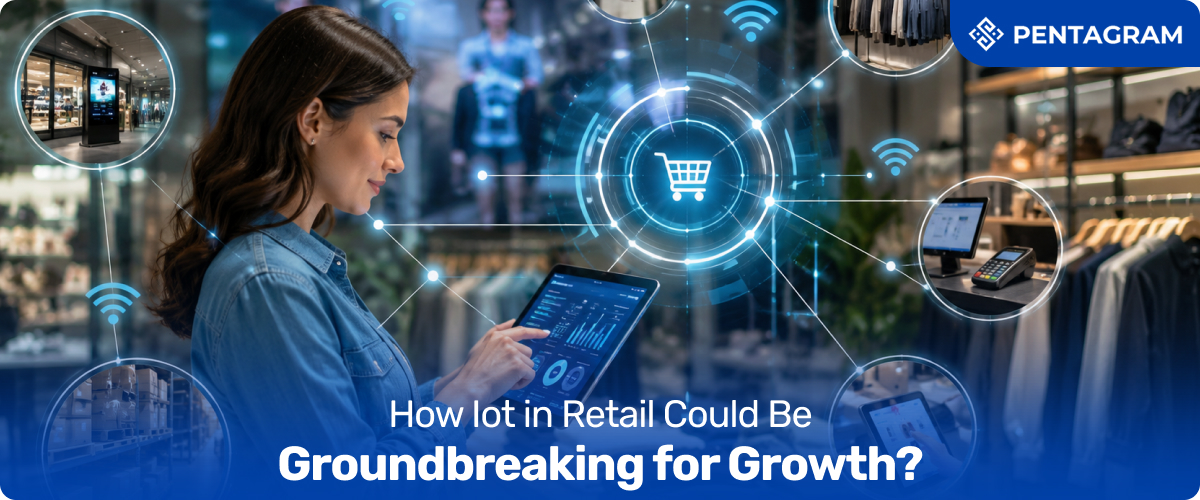
The essence of IoT in retail is inherent in these scenarios requiring order, surveillance, and accounting. This inventory distortion has over the years been the cause of loss of huge chunks of revenue for companies while simultaneously leaving them clueless regarding their own stocks. This compounds over time to become the difference between thriving stores and struggling ones. The layman method of using spreadsheets, manual accounting methods, and other traditional practices that have been previously prevalent has become essentially outdated.
The guesswork and hoping the books and shelves are managed properly somehow only serve to sow doubts within you about your exact stock and within the customers about whether or not to shop there. This comprehensive guide aims to explore how retail businesses are harnessing IoT to unlock unprecedented operational efficiency and how solutions like those offered by Pentagram Systems can accelerate your transformation journey.
A Revolutionary Real-Time Connection
If you are asking what is IoT, then the answer is pretty simple, IoT, or the Internet of Things, refers to the vast network of physical devices, sensors, and embedded systems with digital intelligence that are able to collect, transmit, and simultaneously analyze data across networks spanning a variety of areas and sectors. Its application is simple but its effects are wide-spanning as it turns shelves into intelligent entities that connect and communicate with the master system through the use of sensors, cameras, and payment terminals.
For example: A customer is looking for a size 10 in black, and the product sits three aisles away, but this is just mere speculation on your part. In this scenario your POS system says it’s in stock somewhere while the inventory sheet says otherwise, and this dilemma might result in the loss of an essential sale.
With IoT, however, the product could become theoretically sentient with a simple RFID tag on it, such that the moment someone picks it up, moves it, or leaves it on the wrong shelf the system makes it known.
Essential Features of IoT in Retail
Benefits of IoT in retail can span multiple features to a retail store spanning not only the product inventory but also analyzing customer behavior and insights into the shelving of inventory for optimized sales and customer satisfaction.
- Real-time inventory updates: RFID tags and weight sensors on smart shelves track stock levels instantly to prevent empty shelves. RFID tags attached to products can be read from distance, enabling automatic inventory tracking without line-of-sight requirements. Weight sensors on shelves detect product removal in real-time. Temperature and humidity sensors monitor conditions in storage areas and during transport.
- Optimized cashierless checkout: Connected point-of-sale systems and sensor fusion allow automatic billing as shoppers leave as the price of the system is embedded, which just culminates according to the quantity and the brand of the product.
- Instant pricing updates: Electronic shelf labels change prices wirelessly across the store in real time, thus making the hassle of repricing the entire stock list redundant; instead, a simple click on the integrated software could result in a calibrated change of price or quantity.
- Supply chain tracking: GPS and environmental sensors monitor goods from warehouses to store floors ensuring the quality of the product and the efficiency with which the product is handled.
- Proximity marketing: Bluetooth beacons send tailored deals and product guides straight to a shopper’s phone, which is significantly better than mass targeting advertisement blasts, as these specific customers have a history of previously shopping and thus are more susceptible to buying again.
- In-store behavior tracking: Customer insights are obtained through heat maps and foot traffic captured by highly sensitive and efficient sensors. They show how customers move through and use store spaces. This allows the store to design its infrastructure and stock its inventory in such a way that the most demanded products are highlighted and the most visited aisles are separated from the maze.
What is the Internet of Things and its Relationship to Retail
What is Internet of Things? Is it the same as a connection hub or a modem that creates a local area network for technical devices in its ecosystem?
The Internet of People can also draw a similar comparison with what can be considered social media, where these nonliving entities somehow manage to converse with each other through the power provided to them by technology.
It can be considered a network of physical objects embedded with sensors, processors, and network interfaces that are remarkably capable of collecting, transmitting, and acting on data with a sentient intellect that makes caretaking of these products obsolete. Industry estimates now put the number of connected devices globally above 30 billion, with each shelf, terminal, delivery vehicle, and stockroom generating a continuous stream of operational data.
What is IoT technology is, answered functionally as the correction to the lag that retailers wouldn’t want between their sale, stocking, or stealing of the product and its subsequent update in the system, giving insights with such accuracy that a vigilant guard might have been standing above it.
Due to the lack of heterogeneity of systems in retail, it is often difficult to amalgamate the system with different products having different weights and RFIDs, and thus, this is precisely where most retail IoT initiatives stall. It is thus necessary to reconcile data across vendors, locations, and formats into something a business can actually act on. For retail operators evaluating IoT investment, this is the distinction worth understanding early: the technology itself is mature and inexpensive.
However, the conductor of this orchestra of devices is essential, and that solely depends on the depth of the architecture behind the system. This system is what IoT technologies provide; thus, the more reliable the provider of IoT and the whole server, the better resource management system you can uncover.
The Future of IoT in Retail
The next phase for the implementation of IoT in retail is about closing the loop between that visibility and action, with progressively less of a human standing in the middle to trigger it. Here’s the pathway that’s actually taking shape:
- From reporting to resolving- IoT technologies are shifting from flagging problems to being tasked to act on them directly. This includes recurring but essential tasks like scheduling equipment maintenance before failure and rerouting stock between locations based on live demand signals.
- Autonomous retail agents- Retailers now expect AI-driven agents and not just static dashboards, to be a genuine competitive requirement within the next few years, capable of acting on IoT connectivity data without waiting for manual sign-off
- Battery-free sensing- Rollouts of ambient IoT sensors are proving that connected devices can now be deployed at a pallet-level or item-level scale, which was previously too cost-heavy due to the hassle of installation and repairing.
No surprises and No Alarms: Advocates Pentagram
Pentagram Systems is a leading enterprise connectivity solutions provider delivering comprehensive IoT in retail, along with mobile, cloud, and payment solutions to retail and other enterprises. With 15+ years of combined expertise, Pentagram specializes in enabling retail businesses to harness IoT technology through reliable global IoT connectivity, advanced SIM estate management, and integrated PoS solutions. Their enterprise-grade platform delivers 99.9% uptime across 40+ countries, supporting 500+ enterprise clients with dedicated 24/7 support.
Pentagram Systems brings all these elements together, offering retail enterprises a consolidated platform for IoT connectivity, device management, and integrated payment solutions. Their combination of global IoT infrastructure, eSIM management capabilities, and retail-specific solutions like PoS connectivity ensures that your IoT investments deliver maximum business value.
Frequently Asked Questions
Q1: What is IoT in retail, and how does it differ from traditional retail systems?
IoT in retail refers to internet-connected devices with sensors that collect, transmit, and analyze real-time data about inventory, customers, and store operations. Unlike traditional systems relying on manual processes and periodic reports, IoT enables continuous, automated monitoring. This real-time visibility allows retailers to make faster, more accurate decisions and respond immediately to changing conditions—something impossible with legacy systems.
Q2: How much does it cost to implement IoT in a retail environment?
IoT implementation costs vary significantly based on scope, scale, and existing infrastructure. Costs have decreased substantially as IoT hardware has become more affordable. Most retailers implement IoT progressively, starting with high-impact use cases like inventory management before expanding. The real expense isn’t hardware—it’s reliable connectivity infrastructure. Partnering with established IoT connectivity providers eliminates capital-intensive infrastructure investments by offering managed services models where you pay for connectivity and data, not infrastructure buildout.
Q3: What are the biggest security concerns with retail IoT deployments?
Data security and device security are paramount concerns. IoT devices create numerous entry points for potential breaches. Addressing this requires encrypted data transmission, secure device authentication, regular firmware updates, and strict access controls. Enterprise-grade IoT connectivity providers implement multiple layers of security, from device provisioning to data in transit to storage, ensuring retail operations remain protected while maximising the value of IoT data.

Leave a Reply